Episode 04
November 12, 2026
Get Lost with
Gideon Rubin
Nita:
Hi, Gideon. How are you? We met a year and a half ago, so I kind of know your story. I remember you telling us that you never really got into art until after you went to the military.
Gideon:
I guess I didn't see it coming, you know? My mother is the curator of my grandfather's museum, so I grew up around art. Our house was filled with paintings. I've known art since I was a baby, really. When we used to travel abroad, the first thing we'd do was visit the local museum wherever we went. But nonetheless, it wasn't my thing. It wasn't on my plate. I was a very hyperactive kid, and I couldn't sit still. I never thought I'd be an artist in my wildest dreams. I never thought I'd be anything, really, but becoming an artist was definitely not on the list.
So it was a huge surprise to myself. I was in New York by myself, on a trip after backpacking, and I'd quietly applied to the School of Visual Arts in New York. Then I had to go to an art shop, and I had to tell my parents, because I didn't know anything about art. I barely even knew the difference between oil paint and anything else.I still remember my father's initial shock.
Although my mother is the curator of my grandfather's museum, my father is his son, so the DNA came from that side, really. But I always say that the love of art came from the more academic side, from my mum. It's a very pure love. It's not about making art; it's about the way she looks at and approaches art. It's very beautiful. It has been a close companion to me for quite a few years.
Nita:
When you talk about that feeling, do you think that artistry in general is something that comes innately to a person, or is it learned?
Gideon:
I think for me it's an acquired art. A lot of people have it. When we're kids, most of us have this very encompassing creativity, openness and willingness to take risks. But I think we lose it as we grow up.
But I think it divides into two things. Talent is one thing, but the need to make art is something totally different. Sometimes they coexist, but often they don't.I know that as I started making my work and as I grew up, moving from being a young man to who I am now, it just became a need. There was a calling in me to express something. It allowed me to do things I could never even imagine, things I could never have thought of.
Nita:
I read a story in one of your interviews about your backpacking trip and you trying a drug that kind of gave you that push to try painting.
Gideon:
That was the initial kick. In the 1990s, people would often go backpacking just to get away from everything, which I did as well. I went to South America, then Central America, and travelled by myself. Eventually, I met a very dear friend, and we moved around together, backpacking through South America, Ecuador, Peru and Bolivia. In Ecuador, there was this place, almost like a farm, where we heard there was a cactus that you could drink, peyote. My friend and I went there. We stayed in this beautiful little hostel in the mountains. You would walk down, take the peyote, then walk down to the river and stay there, hallucinating or being high for a couple of hours.
It was a very beautiful experience that opened my mind in a way I wasn't expecting. I've had to think about it a couple of times since. I think the basic understanding of that experience, and what initiated my relationship with art, was this feeling of oneness with the world. For once, for a couple of hours, you understand the world.
As we walked back up to the hostel, I remember talking about life. I guess, as a 22-year-old, you're looking at life and thinking about things. My friend said something like, "You know, why don't you paint?" People used to tell me that throughout my life, often as a joke, because of my family heritage and surname. But I was so out of it that it obviously made some sense.
A couple of days later, he came back and bought me a set of coloured pencils and a notebook.I drew a little with those coloured pencils. I remember it wasn't anything special. They were almost childish drawings. I didn't have any background in painting, so I didn't really feel anything.But then, a couple of days later, we were travelling in Bolivia, and a lovely girl joined us. She was an artist who was going to study at art school. She had watercolours and brushes.I took her notebook, not the one my friend had bought me, and her brushes and watercolours. I was just sitting there, looking at an old colonial building.
I think it was the touch of the brush. It's different from a pencil. The touch of the brush, the hairs of the brush on the paper, almost echoing the building. I had looked at something and drawn it with pencils before, but it didn't have the same emotional impact. Looking at the building and responding to it with watercolours and a brush made me feel something I'd never felt before. There was some kind of truth to it that took me years to cultivate, but it's proved itself. I'm still doing it 30 years later.
Nita:
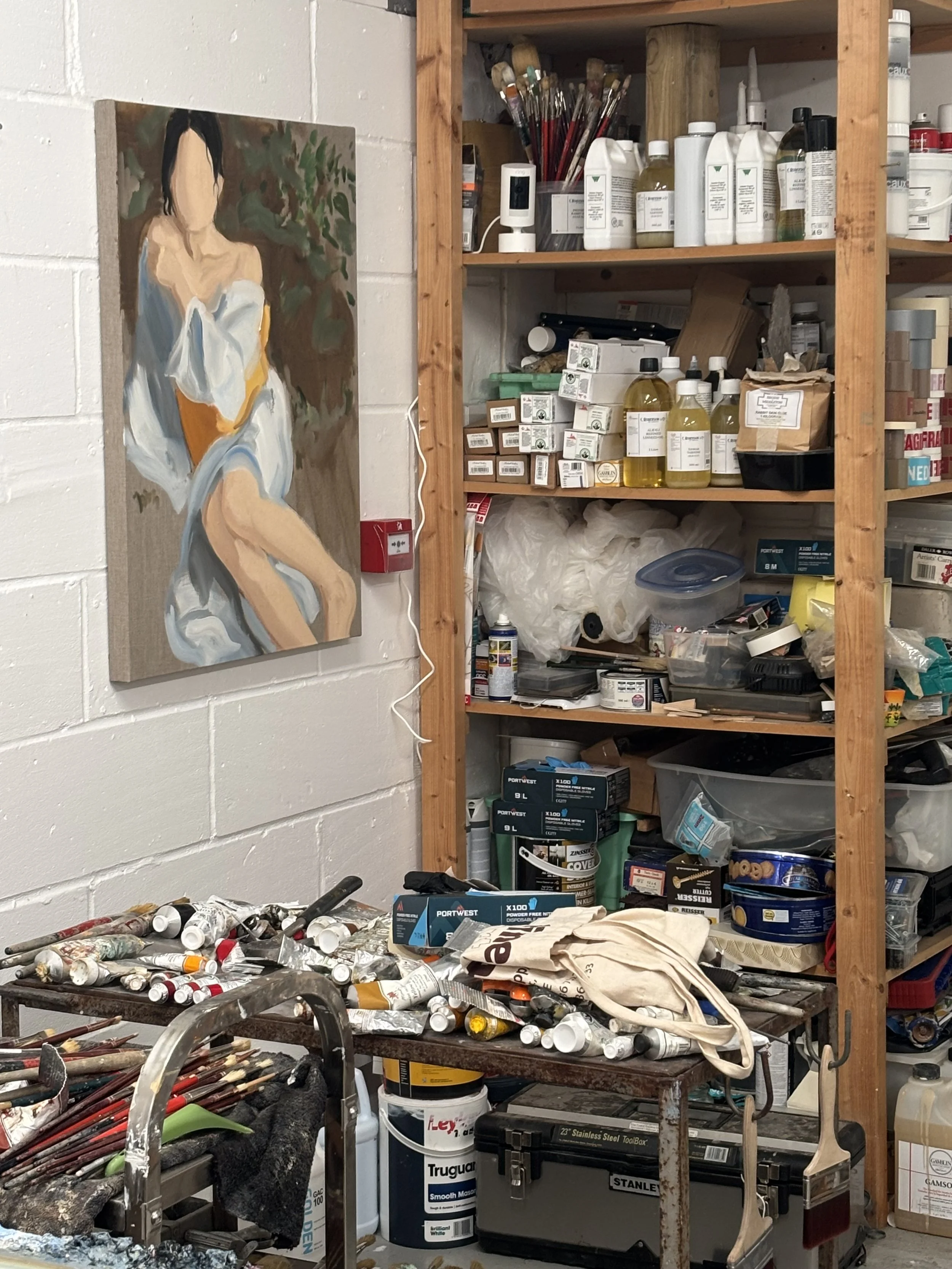
A lot of the paintings you produce are faceless. I know you've been asked about this a few times, and you've referenced its connection to memory. Do you connect it to a certain place? Where does that memory come from?
Gideon:
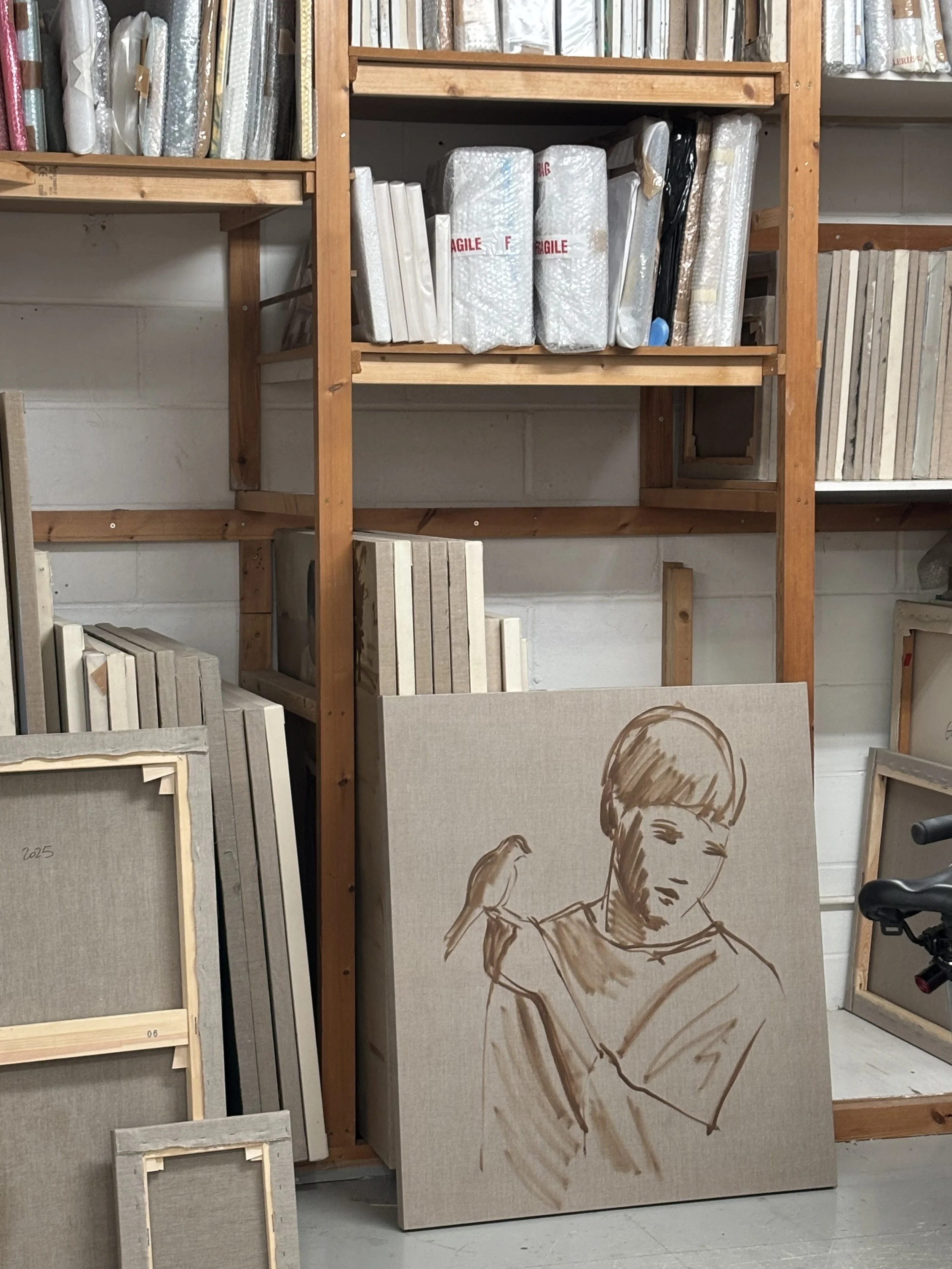
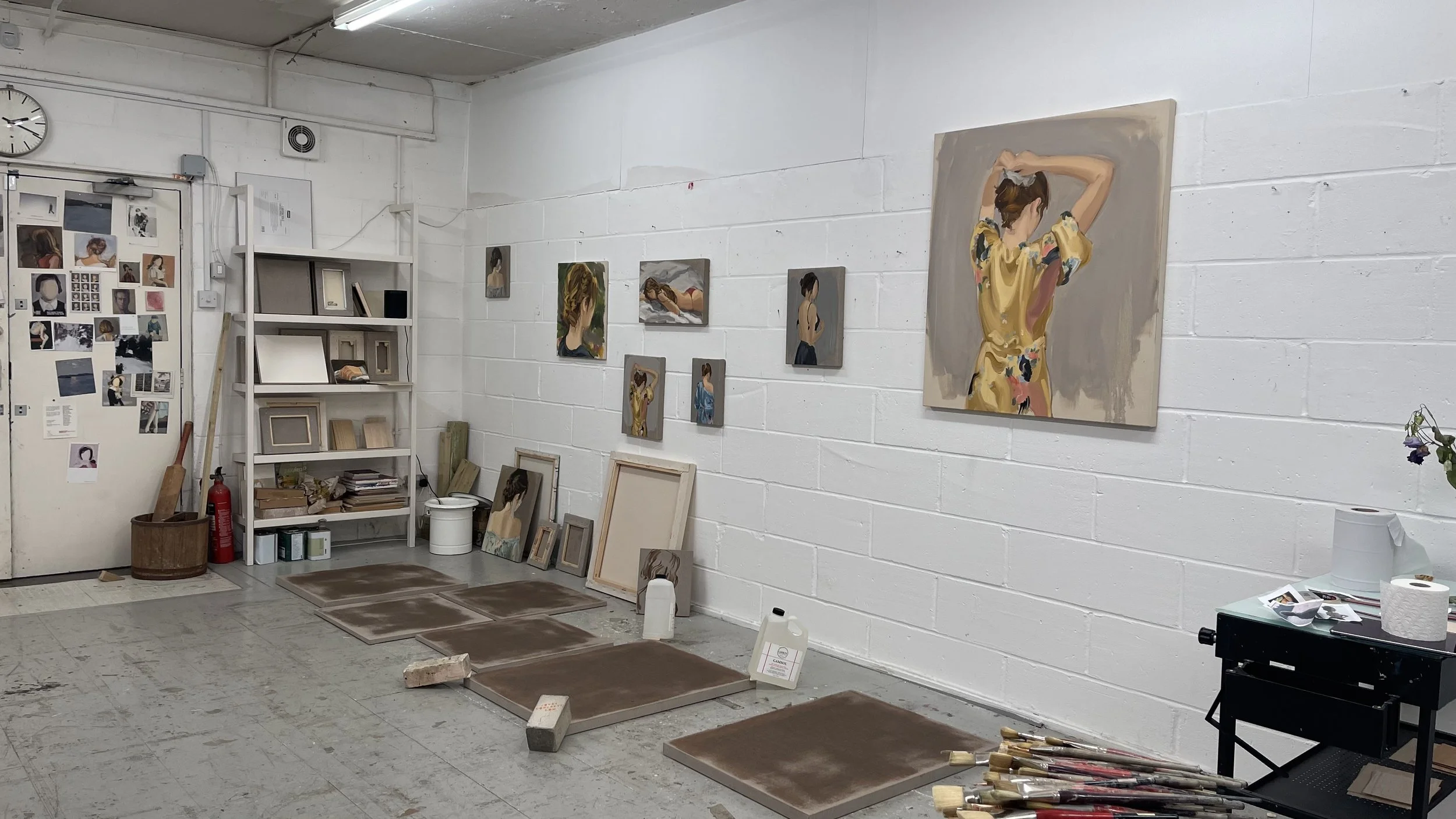
I think part of what has carried on is this openness.Erasing faces or features is a tool that allows me to keep things open. It's like a puzzle. It allows you to flip things and change things, and nothing becomes more or less important than anything else. For me, the figure has to come alive. It doesn't matter if it has a face, no features, partial features, or whether it's facing backwards or forwards. It doesn't matter. The figure has to come alive through the process of painting.
I think part of this thing with faces comes from my interest in antiques, memories and the residue of human life. I can go into markets or antique shops and be drawn to the objects themselves, but also to what they encompass in terms of the people who owned them. The people who held them, played with them. If you look at old Polaroids you find in a bookshop or an antique shop, they're a bit yellow, and they seem to be slowly going out of existence. I find them so captivating and beautiful.
Part of their beauty is that they allow for multiple interpretations. We can put our own stories onto them and bring things into them. It's also about how we experience things directly and indirectly. What happens when we look at an image? You look at the protagonist, but what happens to the people on the side? Sometimes in films, I love looking at things that aren't in the middle of the story, that aren't part of the main narrative, but are just happening on the side.
I'm always interested in that. How to look to the side of things.
Nita:
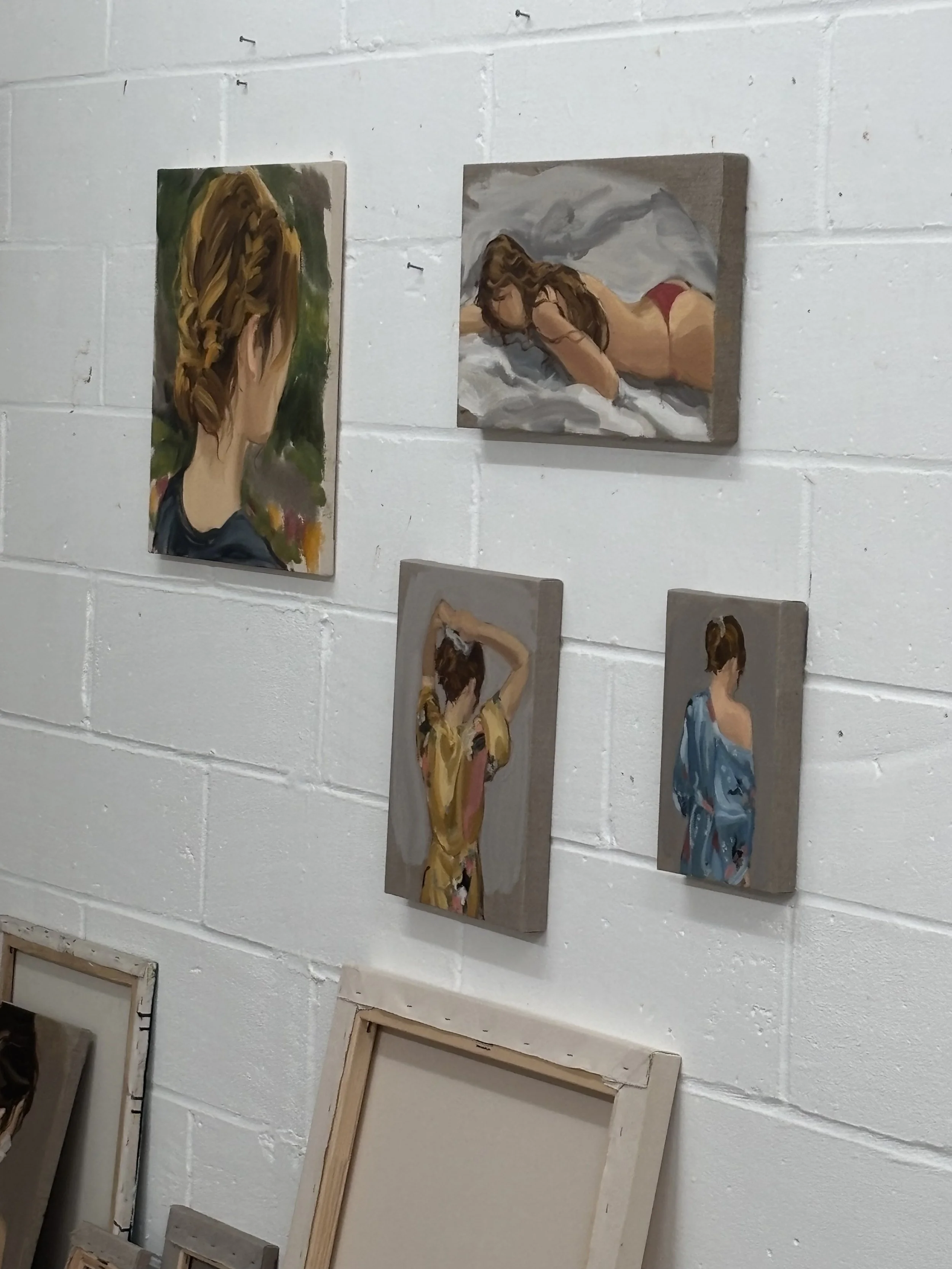
You come from a family of women. You paint a lot of women, and many of them are naked, though they don't explicitly feel sexual, and I wanted to know about your relationship with the female body. How do you want people to understand the female body through your paintings?
Gideon:
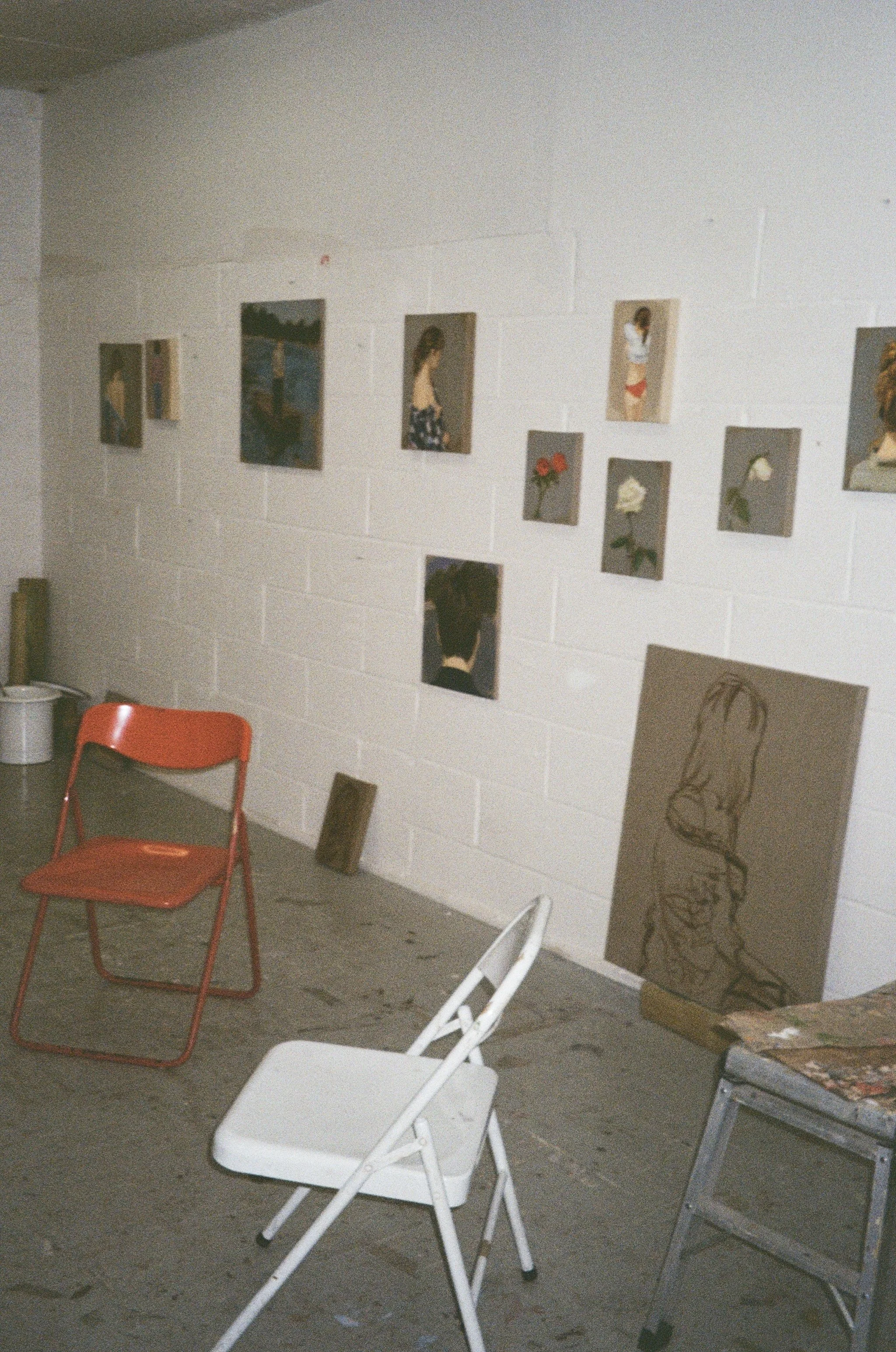
When you start working, you slowly figure out that you need to paint things that are close to you, things that you find interesting. Sometimes you're a bit embarrassed by them. I've always drawn a parallel between nudes and flowers. I felt the same when I painted both. I've always been interested in how we become who we are. From childhood to becoming a young woman or a young man. I've always been quite enthralled by that. I find it exciting because I think it's the moment when we figure out who we are, before we fully understand who we are. That's what I find interesting. The first nude I painted was a little nude painting. She had a yellow sheet. It was one of those images I found online or in a bookshop. It sat with me, as things often do. You look at it and think, "I can't paint that. What is this? Is it porn? Is it something else?"
Of course, the main question is: why? Who needs another nude? Who needs another flower painting? There are definitely enough of them. You think, "This is wrong. I definitely shouldn't do it." But the minute I think that, I go, "Oh, actually, I really should do that. I have to try." The process is the golden rule. If you've done something and discovered something, then you go and do it again. You discover there's a kind of release in realising that it's been done millions of times. Nobody cares. It doesn't matter. The only thing that matters is whether you want to do it. The nude and the flowers are also very much about beauty, inhibitions and something innate.
I'm a father of three girls, you realise that we always confront these things. I remember I just came back from Amsterdam, where I went with a very dear friend who is an artist and his two girls. We went to see Erwin Olaf. His work is incredibly sexual. My friend asked me about it, and I said, "Yeah, my girls go to these things. It's part of us."
Nita:
When we were looking through your work, one piece that really stayed with me was the exhibition you did in the chapel with Louise Bourgeois. I remember there was music accompanying the exhibition, Playground Love by Air. Do you listen to music when you work? Is it something that inspires you?
Gideon:
I pretty much always listen to music. I remember being at the School of Visual Arts and having a class called World Music. It wasn't popular music; it was local music from different regions of the world. I found it incredible. It's an experience I'll always take with me. That specific project in the chapel, when I did the exhibition with Louise Bourgeois and Nicolas Godin, was different because, for the first time, I'd done something where I needed sound.
When I came into that chapel, I got the space first. I remember sitting there and being blown away by this little chapel, which had never been shown to the public. It belonged to nuns who used to run a foundation that took care of homeless people. I remember sitting there, looking at this very beautiful little chapel and thinking, "I just want to slow time down."
I thought that, for an artist or for people who experience art, it's a little bit like finding something in our short human existence that gives us a place where we feel secure, somewhere we want to stay. Through various attempts and experiments, I initially thought about a kind of stained-glass sound, something with meditative qualities.
Then, through luck, the stars aligned, and I managed to meet Nicolas. I remember the first time he sent me what he'd made. He said he wasn't even sure if it was finished. I thought it was perfect. It had this very beautiful, quiet sound, and he had a heartbeat in there that sounded internal.
I thought that was just right. It also echoed the building. It all worked together. It was beautiful for me to see people's reactions to experiencing it. Obviously, it's difficult for me to talk about my own work, but there were three pretty perfect Louise Bourgeois sculptures in there, and his sound was perfect.
Nita:
I'm going to ask you one last question. Do you think art, in your artistry, is a healing process for you? Is it a form of rebellion or therapy? How would you describe it?
Gideon:
I think that's a good question. As I mentioned, things change and move around, and they connect. That's where art comes in. It's not just an extra thing in your life. How do you say it? It's not a necessity. It's a privilege. Maybe we don't need it as much as food, but it's food for your heart. It's food for your soul. These things exist. We sometimes treat them as if they're optional, as if we can take them or leave them. But it's a need. And it needs to be cultivated. It needs to be taken care of. It needs to be investigated, and you need to use it in order to experience your human life. If you don't, you only experience part of it. And it's really... I mean, we see it everywhere.
Art gives me a way to deal with things that I can't deal with in any other way.