Episode 01
June 10, 2026
Get Lost with Polina Kadilnikova
Nita:
Today we’re with the designer Polina Kadilnikova. First of all, congratulations on winning the L’Oréal Prize. I wanted to ask you, what’s your journey from Ukraine to Central Saint Martins?
Polina:
Well, I moved to the UK for a foundation, but I didn’t go to CSM straight away. I moved to Manchester when I was 16 and wanted to do fine art. There was a really good tutor who said that my paintings weren’t as strong as my 3D work, so he suggested that I do sculpture. I was like, “I don’t want to do sculpture,” so I ended up doing fashion. It’s really funny how I ended up here because I never actually planned to study fashion or go to CSM.
Nita:
Would you say your paintings and your experience in fine arts affect your designs?
Polina:
I think, in a way, I was always a very creative person. Painting did affect my work because I do a lot of illustrations, but it’s also the reason why I’m so attracted to mixed media. My practice is very fluid, I’m not just focusing on fabrics. I’m always using different materials, like metal and wood, and I think it did really help me with my work in the end.
Nita:
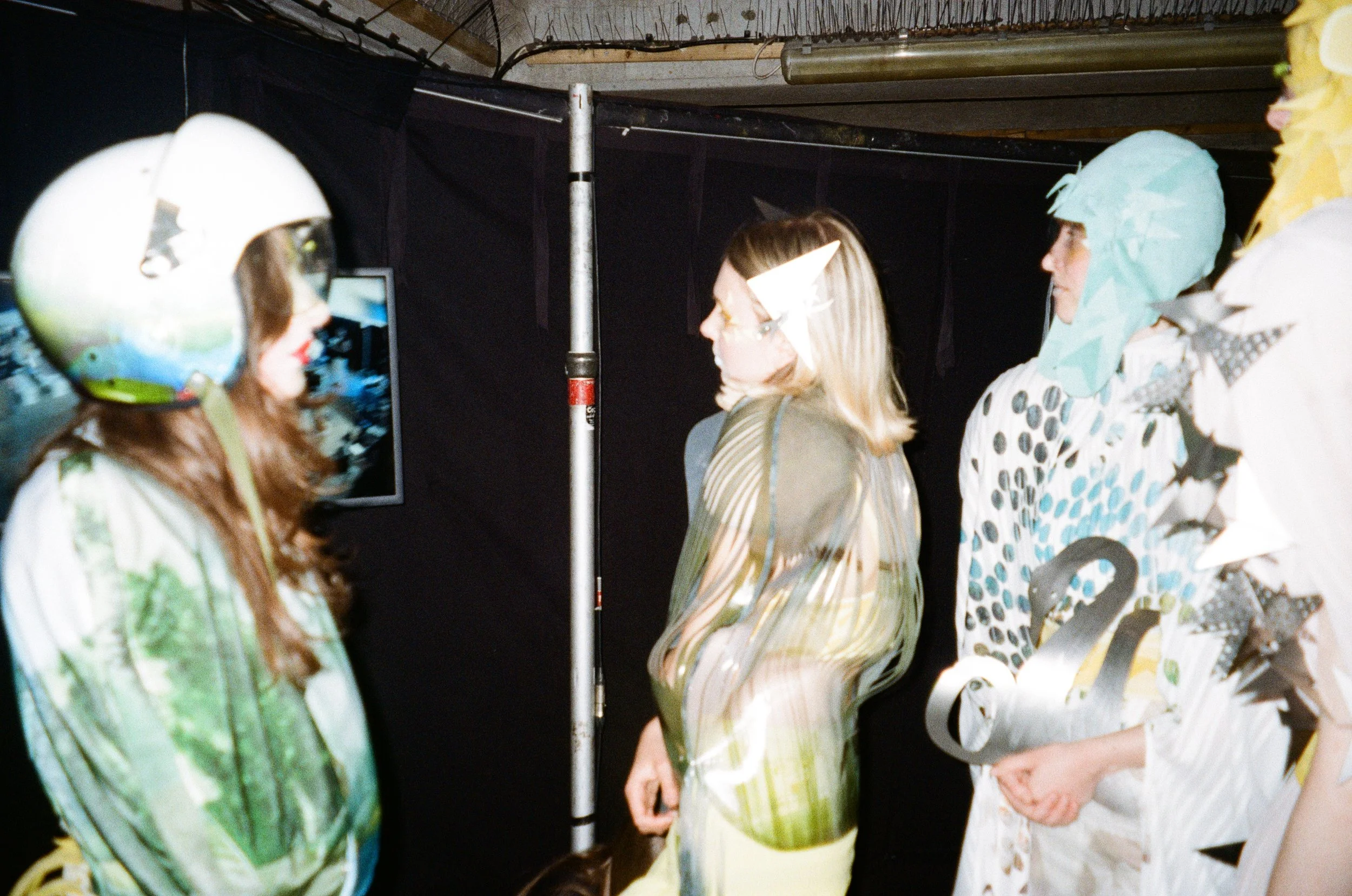
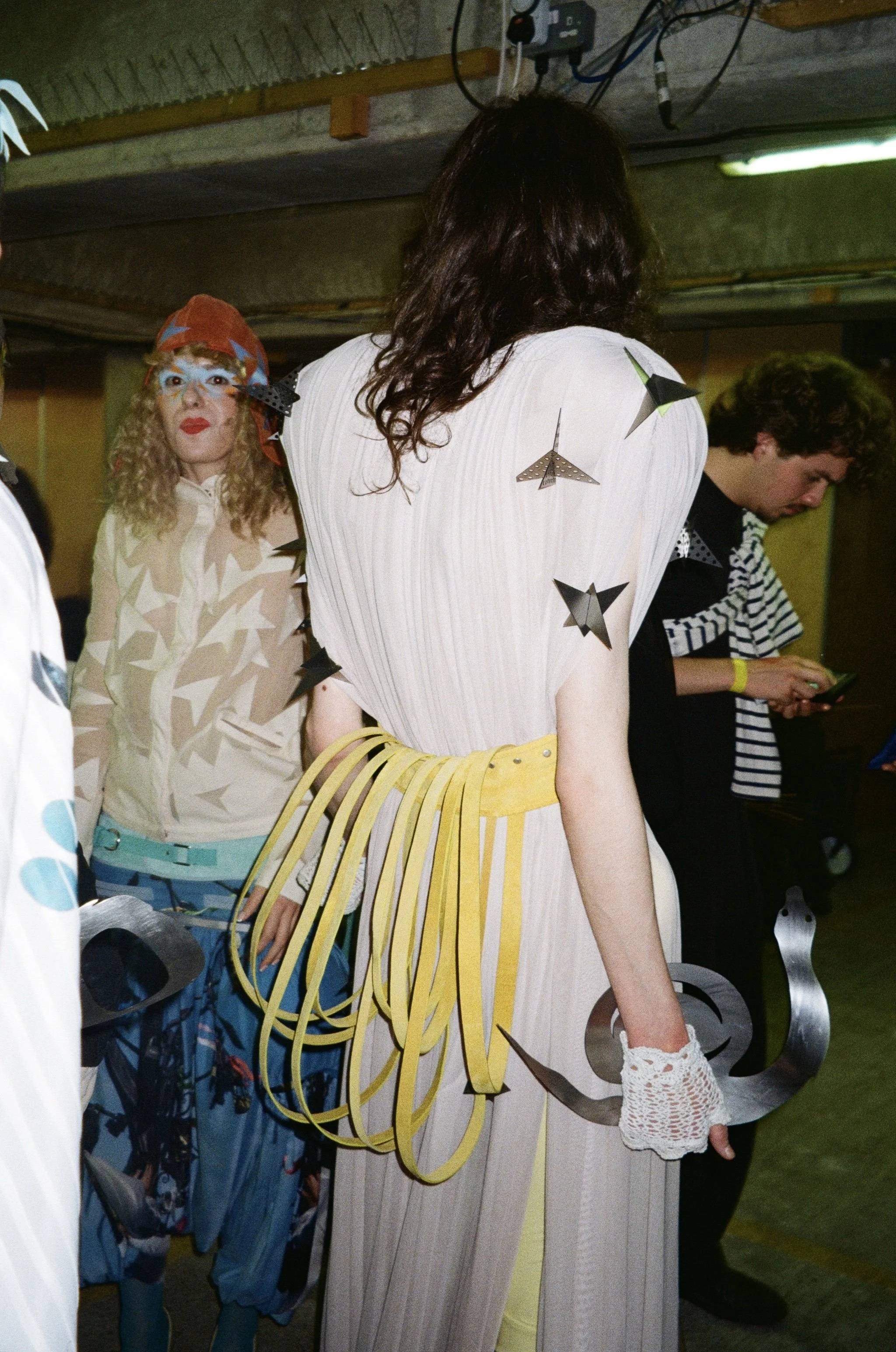
Your collection features these recurring figures, like the metal swans. What was the symbolism behind them?
Polina:
Because I was talking about nostalgia for the past and home, we have a really famous technique of decorating children’s playgrounds where people take unused car tyres and cut them into these shapes, which were mostly swans. It’s just a cheap way to decorate the playground, which I thought reminded me of my childhood. Since all of the shapes I used for my collection did have a reference back to Ukraine, or to something in the past that doesn’t exist anymore, that was just more of a nice memory that I keep thinking about.
Nita:
You also use a lot of prints and photographs throughout the collection. How did you go about finding them, and what drew you to those particular images?
Polina:
Yeah, since I wanted to translate this feeling of nostalgia over times of peace, I wanted to find out what that meant to me first. So I looked through a lot of pictures of schools, weddings, just field pictures, nature pictures. I wanted to see which ones I had a reaction to. On one of the pairs of pants I used just a picture of a random wedding from 2010, and the reason I picked it, I think, was because the colours just kind of screamed peaceful times. It is really sad because most of those cities are not really peaceful right now.
A lot of different photographers would go to Ukraine and take pictures of it from their perspective. There was one series which I was really inspired by, by a contemporary Ukrainian artist. She did a series on taking pictures inside hospitals. The thing is that the interiors of hospitals in Ukraine are really specific because they all use this high intensity of colour, but not high enough—it’s kind of its own thing. That’s why her series, which was called Anguish in Green from 2009, really inspired my whole collection.
Nita:
What else do you look to for inspiration? Or is it just Ukraine in general?
Polina:
I think all of the references did come from within Ukraine. I just looked at different objects and people’s daily lives. When I went back, I would just look at buildings and see what they made me feel. That was one of the main points of my collection. I didn’t want to add anything that’s not connected to Ukraine—to create something so within the country, where you take this traumatic past and present and you live past it to create something new.
Nita:
It’s kind of like a way of reparation.
Polina:
Yes. I wrote a paper for my dissertation based on another Ukrainian scholar, and she said that the only way we can kind of grow from our erased past—because we had a really long history of the Soviet Union trying to erase our culture, and then we never really had the time to recover after that, and then we got another ongoing war—so the cultural state of the country is very fragile. And, of course, there are no funds or emotional state to create art that’s not connected to war. But she said the only way we can establish ourselves within the world is just to continue creating art and culture within our country.
I felt like that was important because wars don’t trend on the news always, you know? They trend for a little bit and then people forget about them. And I wanted, by being here and using this spotlight of being at Central Saint Martins, to talk about it. It did confuse me when I would come back from Ukraine to here, hearing people not knowing anything about what’s going on in the world.
Nita:
I think it reminds me a lot of Stuart Hall’s work on cultural identity, the idea that, after a history of repression, you can’t simply separate the present from the past. You have to engage with that past and transform it into something new. I kind of think your collection follows the same line of thinking.
You use a lot of forms of helmets in your work. Is that connected to military wear?
Polina:
I was looking at places and objects, but I also looked at people. I was saying how, since the start of the war, the country is creating soldiers and nurses mostly because that’s what the country needs. In the cultural state we’re in, we are losing a lot of development, but we’re advancing with war memorabilia and uniforms.
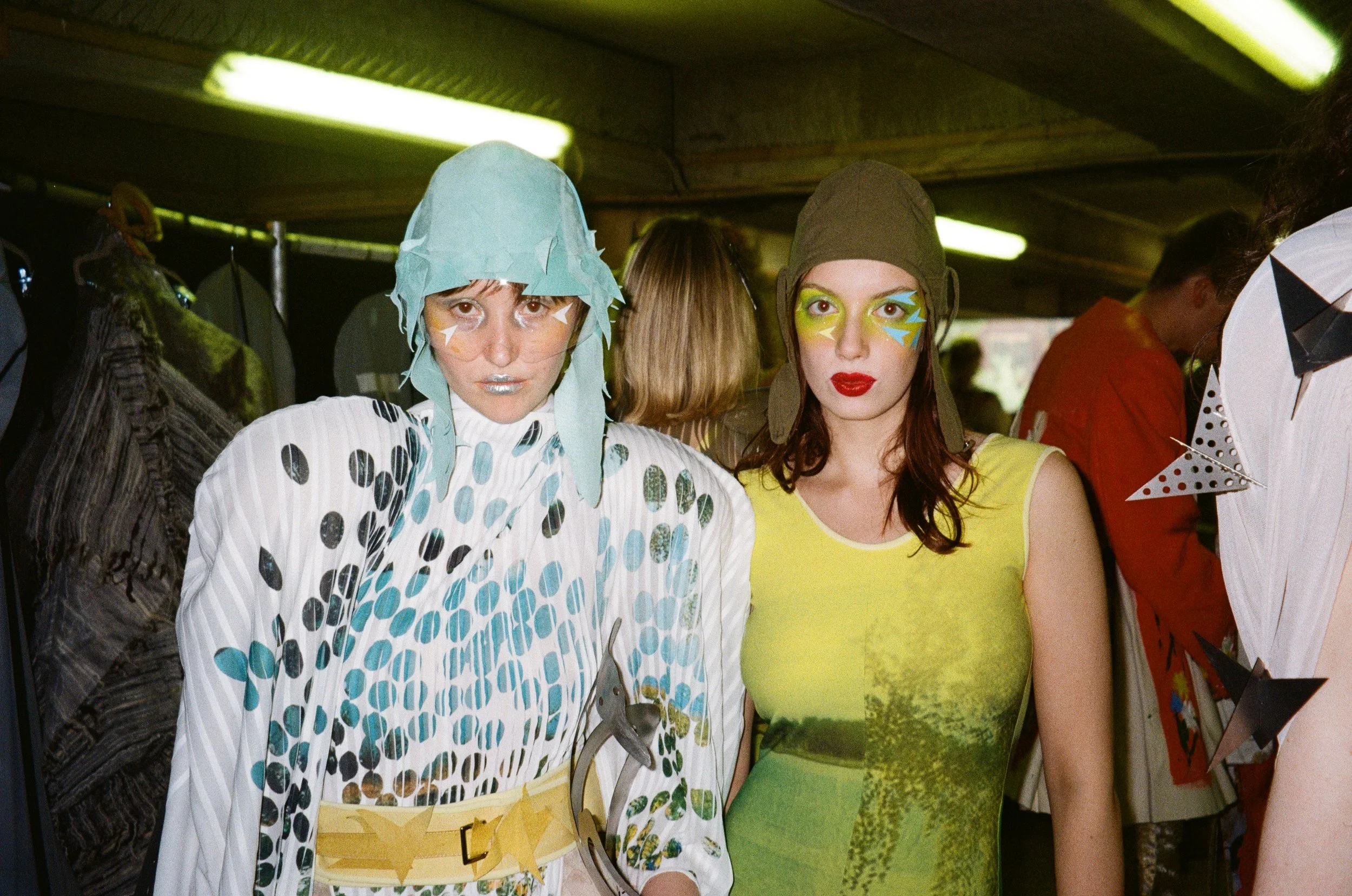
Both my mum and dad were studying in an aviation school, and my grandfather served in the military as well. So, in one way or another, our traditional uniform is connected to military wear and infuses with our normal traditional garments. Thus, I kind of mixed this utilitarian uniform with traditional Ukrainian garments.
Nita:
What are the purely traditional Ukrainian silhouettes that you used?
Polina:
The pants were derived from a garment called sharovary, like fighters’ pants. And then the shirt was similar to the traditional vyshyvanka. They were changed in the process, the detailing was referencing the military uniform because it was, again, a way of creating this new uniform.
Nita:
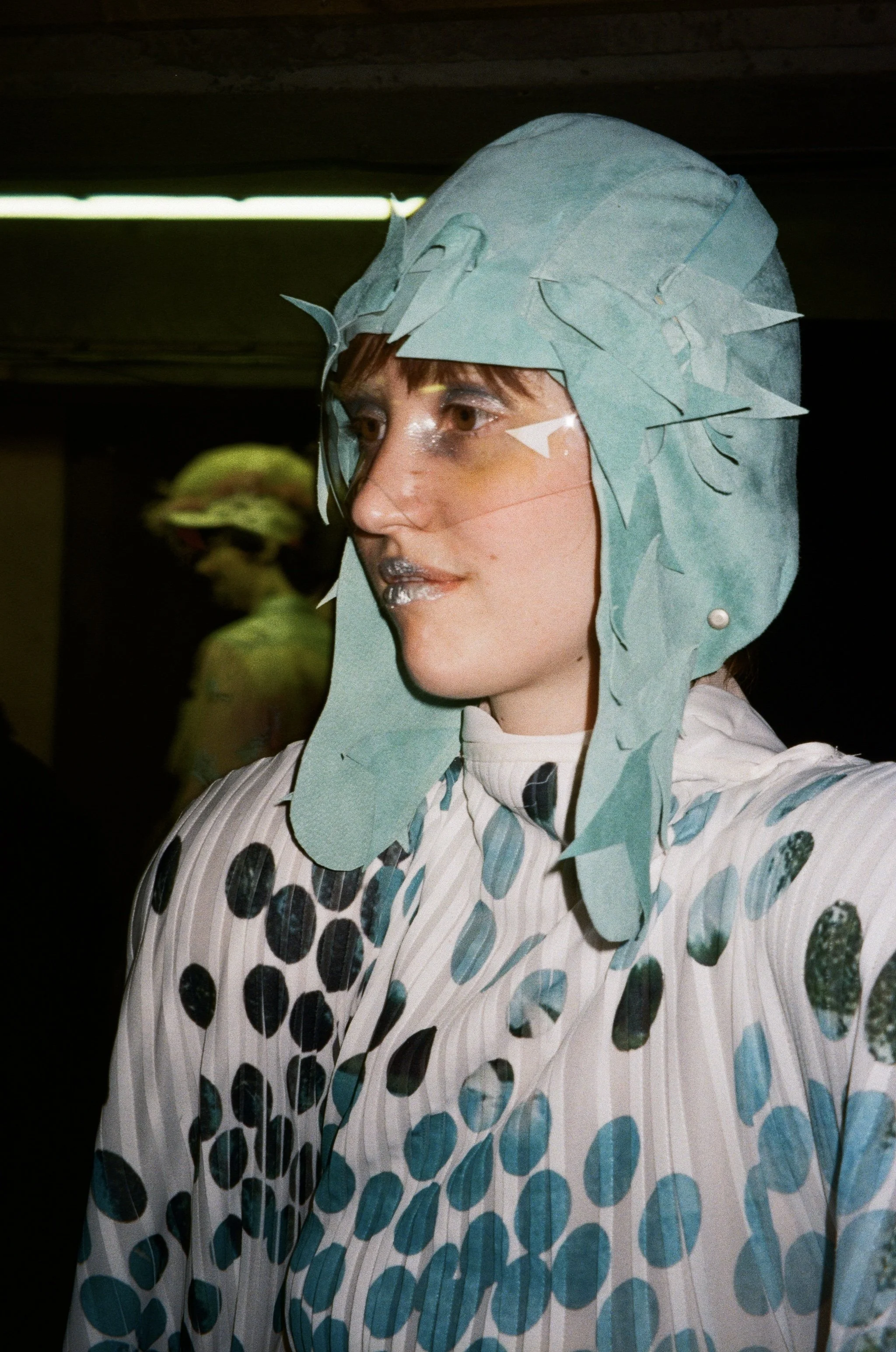
From my perspective, when I was modeling for you, I think the makeup acted as camouflage, in a sense, that tied in with the whole outfit. What was your inspiration for the makeup looks?
Polina:
For makeup, I referenced my illustrations, coming back to my fine art background. I think that’s just the way I drew faces, where I would put so much colour in to emphasise this sad look, but also one full of desire to fight.
Nita:
Were you expecting to win the L’Oréal prize?
Polina:
No, I didn’t, because I think the reason why I enjoyed this year so much was because I never designed my collection to win the L’Oréal Prize. I just had an idea. My goal was to do the project to its best potential because I think it would be really sad for me not to execute it well enough, considering how serious of a matter it is. I just wanted it to be as good as I could. So, until that last moment, I didn’t see that coming.
Nita:
I think it’s so successful because you can tell it’s so personal, and it doesn’t simply portray a tragic narrative. The music contrasted that, and you could feel the presence of the tragic reality, but in a way it seems very optimistic. Do you think that’s your message?
Polina:
I do think maybe if I had to do the collection in Ukraine, it would look very different because it’s much easier to explain those emotions to people who actually live through it. But it’s very different addressing these types of subjects in Western Europe. Obviously, not everyone can relate to what I’m saying, and I didn’t want to create a costume of trauma. I wanted it to be more of a nostalgic overview of our culture. I think that was a very interesting perspective that I took. I wanted it to be much more of a hopeful perspective.
Nita:
And for my last question, what do you think you want to translate with the art that you create, or what audience do you want to speak to?
Polina:
Honestly, I feel like, again, being here is such an interesting place to be because you never know who your story can reach. Being in such a liberal arts university, I do expect people to follow the news much more closely because it’s a part of being a creative. I feel like work always needs to be political, on either side you’re interested in. When I first started the project, I did get a lot of feedback with zero knowledge about what’s happening anywhere, and it really frustrated me. So… I want to be heard by an audience that doesn’t really pay attention to anything, maybe to spark an idea to look at what’s happening.
At the same time, I’m really happy to be seen by different Ukrainian creatives. It’s nice for me to hear that I talked about this topic well enough; I had this fear of trying to translate this tragedy and not reaching the point well enough for it to be told.
Nita:
Polina, thank you so much. First of all, thank you for letting me be part of your collection. It was so nice to be around the community of Ukrainians. You can sense the connection that you guys have, and you should be so proud of yourself. How does it feel to be EVERYWHERE?
Polina:
It was really overwhelming for the first three days, and then I feel like I still do not fully grasp that I won something.
I think because most of my team, my helpers, were Ukrainian, when they said my name, to see everyone being so happy; it was just such a moment. Because years after me, after I’m going to graduate, there are so many Ukrainians here and people from Eastern Europe as well, and I feel like it’s just such a big moment to understand you can really be anything, I guess…
find the video interview below: